RECOVERY
OVERVIEW
You already know that after a game or heavy exercise, you’re going to be sore. But what is it and why can it be bad? You get sore with DOMS (Delayed Onset Muscle Soreness) because the activity has created tissue injury and inflammation. It occurs with training above what you’re used to or with a change in type or intensity of your workout (1). You start to feel DOMS within the first 24 hours and it can keep getting worse up to 72 hours after your workout. Most soreness starts to fade after that, but it can last up to 7 days if the workout was overly heavy and intense (2).
Feeling sore and fatigued after a workout is normal, but it does have an impact on the body. It causes increased fatigue, decreased muscle output, and a change in how your joints feel. It can also cause your muscles to not grow stronger and cause an increased risk of injury if not taken care of properly (2,3).
The goal with exercise is to see positive gains and then be back to baseline as quickly as possible to be prepared for your next activity. This is where recovery comes in. There are lots of different recovery tools out there – some endorsed by celebrities, some very expensive and fancy, and some ingrained in our lives by childhood PE teachers. So what actually works? Which one should you invest your time, energy, and discomfort in?
RECOVERY TOOLS
Stretching really isn’t that helpful for recovery. Most studies have shown that it is not helpful and does not help with a faster recovery or decreasing muscle soreness. There are some theories that static stretching (hold a stretch for whatever length of time) right after exercise can cause more damage (1,2,4).
Stretching can still have benefits – check out the Mobility section for more information.
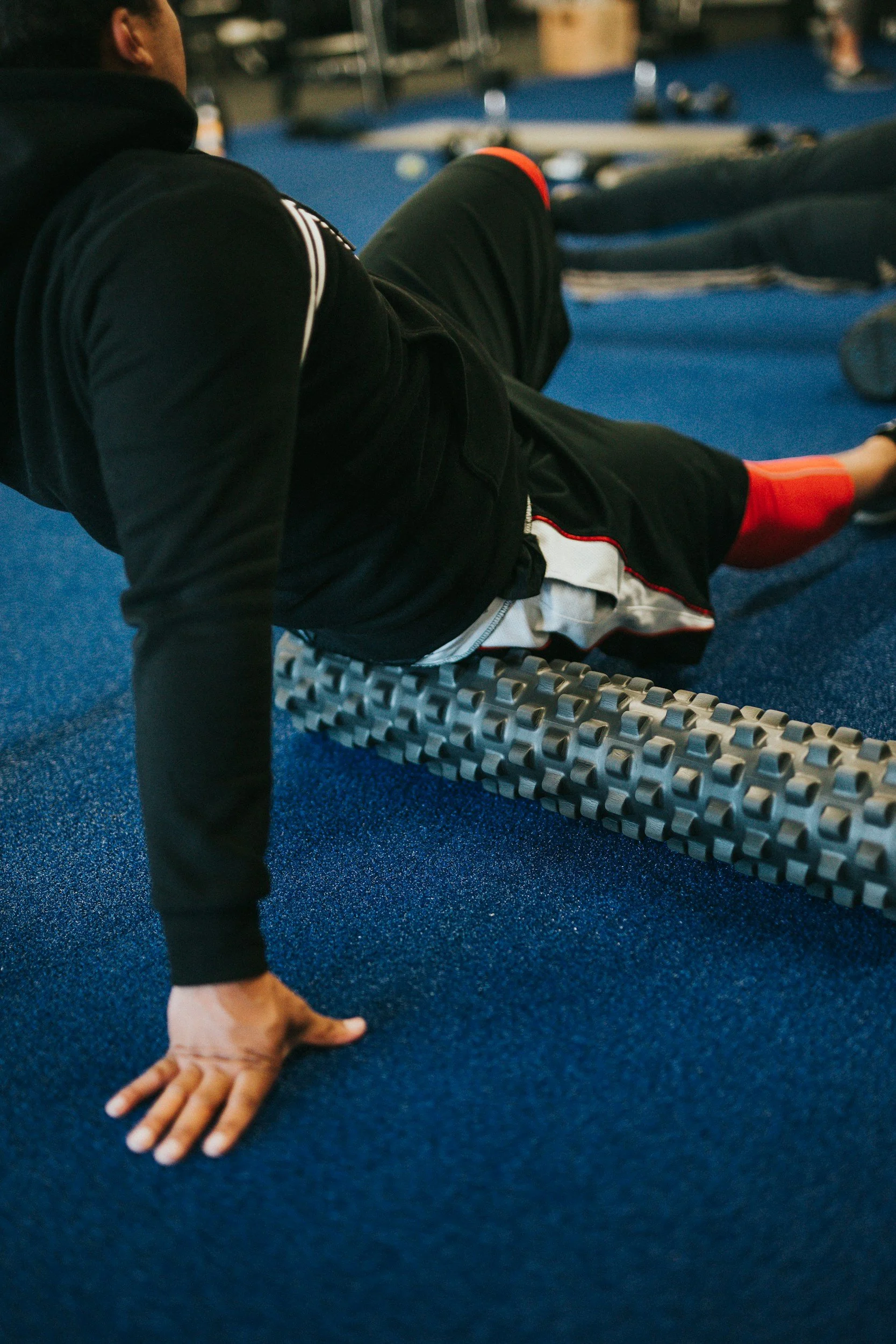
Foam rolling has been shown to help reduce pain after exercise, perceived soreness, and has helped get muscle function back (2,5,6,7). It is also likely helpful in increasing range of motion (4).
How to do it effectively: 1 to 3 sets, taking 2 to 4 seconds per roll in one direction over the length of the muscle being worked on, for between 30 to 120 seconds total per set (4).
It is best done multiple days in a row after exercise for full effectiveness.
It can also be done for a warm up too.
Compression devices have mixed evidence for decreasing feelings of soreness, but may help with feelings of muscle tiredness. Some compression devices you wear for only a few minutes (the ones that actively squeeze your legs), and stockings can be worn for hours. Stockings worn for 24 hours after exercise does provide help in the muscles feeling better, but it likely doesn’t help with muscle strength recovery (2,3,4).
Massage can be pretty effective when done right after a workout or up to 2 hours after. It can help with fatigue, soreness, and with muscle strength recovery (2,3,4).
Cold water immersion ( ice baths) seem to be effective after high-intensity exercise (think heavy team sports) and helps with pain relief. It may not be helpful if you’re trying to build muscle. This may not be as helpful in the elite athlete but it likely doesn’t have any negative effects other than being cold (2,4).
Whole-body cryotherapy (tanks that you stand in that drop the temperature quickly) may also be helpful but may depend on the older adult's perception and views on it (4).
Full-body vibration is a not a newer recovery technique, but is becoming more popular, but the studies are still being done, and may not be available for everyone (3,5)
Percussion therapy has two systemic reviews (e.g., theraguns) were published in 2013. Both of these reviews had a small number of studies where greater than 75% of participants were men. Both noted lots of biases from the studies used and gave mixed and sometimes conflicting results. (8,9). These tools may be useful for short-term recovery and may help improve range of motion and flexibility. They may be detrimental if used right before explosive or strength exercise.
Use low frequencies (<40 Hz) for more than 2 minutes for recovery
Use high frequencies (>40 Hz) for less than 2 min for range of motion and flexibility
Use the ball tip applicator over the muscle you’re working at a moderate speed of movement with gentle pressure
SLEEP
Quality, consistent, and appropriate quantities of sleep are known to help younger athletes.
While the evidence may not be as robust, the same is thought to be true in elite athletes, which may be even harder to achieve given typical age-related sleep pattern changes (waking up more frequently, insomnia, medication side effects, change in circadian rhythm, etc.) (4).
Generally speaking, seven or more hours per night is needed to reduce the risk of injury and aid in recovery (10).
NUTRITION
If you’re looking to build muscle and stay competitive, you need to eat. For recovery, timing your nutrition is important. Aim to get a mix of carbs and protein within 30 minutes of heavy exercise.
Carbs are not the enemy. 40–90 grams are needed per hour of heavy effort to help keep your energy stores high and prevent excess fatigue (10). This is the same whether you’re 20 or 60 years old (4).
Protein is great right after exercise (aiming for 20–30 grams depending on your exercise) to help build new muscle and repair any damage (10).
Older athletes should aim for greater than 0.4 grams of protein for every kilogram of body weight (4).
It’s important to note that most older athletes don’t reach these guidelines, so make sure you’re getting the right amount.
Supplements may be helpful. Healthy fats like Omega-3 fatty acids help keep joints healthy as well as decrease chronic inflammation and perceived soreness. Polyphenols are antioxidants and can help recovery. Creatine monohydrate might help prevent unintended muscle damage (2,10).
Drink water! Staying hydrated helps keep the joints moving, the muscles loose, and the body in motion.
RECOVERY ISN’T JUST DONE ONCE
What you do right after a workout is important. What you do hours and days later matters too.
A 2026 literature review, Starzyk, et al., 2026, recommended breaking your recovery into three phases:
Immediate (0–2 hours): Make sure you’re eating to refuel with protein and carbs. A recovery method like message, foam rolling, or percussion may be helpful.
Acute (2–24 hours): Sleep is key. Now might be a good time for the antioxidants, Omega-3s, and compression stockings/clothes.
Peak DOMS (24–72 hours): Keep moving. Consider more foam rolling, message, and percussion.
AGING & RECOVERY
Does aging make recovery harder?
The short answer is no, not really – but also yes.
Exercise causes muscle soreness and brief decline in strength no matter how old you are. However, it has been shown that muscle strength recovery is not that different in younger and older athletes. This is especially true with aerobic exercise and is likely true with resistance training. However – there may be a change in how older athletes think they recover and how tired they feel they are, which can prolong recovery. (4, 11).
What to do about it? Eat more protein after a workout. Make sure you do recovery activities.
Elite athletes tend to not do either of these enough. So to prevent injury, speed up recovery, and get back to activity faster, find a routine that works for you.
TL;DR
Unfortunately, life may get in the way of some of these recovery tools due to time, money, or availability. And that’s okay. You have options.
Foam rolling is going to be a highly accessible and affordable recovery tool, but if you hate it, then don’t do it. The key is to find a method that works for you. What you use may change based on your workout, time, life stage, or preference. The most important part is that you feel it helps and that you actually do it.
Active recovery is better than no recovery.
REFERENCES
Warneke, K., Thomas, E., Blazevich, A. J., Afonso, J., Behm, D. G., Marchetti, P. H., Trajano, G. S., Nakamura, M., Ayala, F., Longo, S., Babault, N., Freitas, S. R., Costa, P. B., Konrad, A., Nordez, A., Nelson, A., Zech, A., Kay, A. D., Donti, O., & Wilke, J. (2025). Practical recommendations on stretching exercise: A Delphi consensus statement of international research experts [Consensus]. Journal of Sport and Health Science, 14. https://doi.org/https://doi.org/10.1016/j.jshs.2025.101067
Starzyk, R., Śmiałek, S., Florek, J., Cholewa, D., Guzik, N., Jaklik, D., Słaby, W., Groele, A., Dębska, P., & Miczek, M. (2026). Effectiveness of recovery methods in reducing delayed onset muscle soreness (DOMS): A narrative review. Quality in Sport, 49, 66860. https://doi.org/10.12775/qs.2026.49.66860
Dupuy, O., Douzi, W., Theurot, D., Bosquet, L., & Dugué, B. (2018). An Evidence-Based Approach for Choosing Post-exercise Recovery Techniques to Reduce Markers of Muscle Damage, Soreness, Fatigue, and Inflammation: A Systematic Review With Meta-Analysis. Frontiers in Physiology 9. https://doi.org/10.3389/fphys.2018.00403
Reaburn, P. R., & Fernandes, J. F. T. (2023). Exercise stress and recovery in active ageing individuals and masters athletes. In M. Kellmann, S. Jakowski, & J. Beckmann (Eds.), The Importance of Recovery for Physical and Mental Health: Negotiating the Effects of Underrecovery (pp. 242–265). Routledge. https://doi.org/10.4324/9781003250647-14
Kim, Y. S., Kwak, J. J., Park, H. G., Lee, W. L., & Lee, K. J. (2026). Effects of Post-Exercise Recovery Interventions on Visual Analogue Scale Scores, Blood Lactate Concentration, and Isokinetic Muscle Function Following Muscle Fatigue in Amateur Swimmers. https://doi.org/10.3390/app16094245
Rodoplu, C., Fischer, J., Burger, C. et al. Acute effects of foam rolling vs. passive rest following a single bout of complex contrast training. Eur J Appl Physiol (2026). https://doi.org/10.1007/s00421-026-06188-8
Rossi, L., Fonseca, G., Ribeiro, D., Fukusawa, L., Hespanhol, L., Macedo, C., Santos, J., Lourenço, B., Miranda, J., & Oliveira, V.. (2026). Efficacy of Recovery Strategies in Reducing Post-Exercise Pain Intensity: A Systematic Review and Meta-Analysis. The Journal of Pain, 41, 105845. https://doi.org/10.1016/j.jpain.2025.105845
Ferreira, R. M., Silva, R., Vigário, P., Martins, P. N., Casanova, F., Fernandes, R. J., & Sampaio, A. R. (2023). The Effects of Massage Guns on Performance and Recovery: A Systematic Review. Journal of Functional Morphology and Kinesiology, 8. https://doi.org/10.3390/jfmk8030138
Sams, L., Langdown, B. L., Simons, J., & Vseteckova, J. (2023). The Effect Of Percussive Therapy On Musculoskeletal Performance And Experiences Of Pain: A Systematic Literature Review. International Journal of Sports Physical Therapy, 18(2). https://doi.org/10.26603/001c.73795
Forelli, F., Moiroux-Sahraoui, A., Nielsen-Le Roux, M., Miraglia, N., Gaspar, M., Stergiou, M., Bjerregaard, A., Mazeas, J., & Douryang, M. (2024). Stay in the Game: Comprehensive Approaches to Decrease the Risk of Sports Injuries. Cureus. https://doi.org/10.7759/cureus.76461
Reaburn, P. (2021). Age Related Physiological Changes in Masters Athletes. In B. Callary, B. W. Young, & S. Rathwell (Eds.), Coaching Masters Athletes. Routledge.